
Political polarization has moved beyond public discourse into the most intimate spheres of life, turning disagreement into identity and fracturing families, friendships, and inner worlds. This discussion explores what psychoanalysis can offer when the capacity for ambivalence collapses and the shared moral universe we once inhabited no longer exists.
Across the Western world, political polarization is no longer confined to parliaments and public squares — it has entered the consulting room, the family dinner table, and the most intimate relationships. What makes this moment historically distinctive is not merely that people disagree, but that disagreement has become identity. Patients speak of feeling like strangers to their parents, their siblings, their oldest friends — people with whom they once shared a common language of values. A Jewish family finds itself torn between Zionist and anti-Zionist convictions; Israeli siblings stop speaking over their stance on the current government; lifelong friends in the United States discover, after January 6th or after October 7th, that they inhabit entirely different moral universes. In Germany, debates over migration, memory, and solidarity have fractured communities that once seemed cohesive, creating new alliances across old divides while severing bonds that once felt unbreakable.
What the couch reveals is that this splitting operates psychically as much as politically. The world becomes divided into the righteous and the guilty, the enlightened and the complicit — and the capacity for ambivalence, for holding complexity, quietly collapses. At the same time, the split produces its own consolations: new communities form around shared outrage, offering a sense of belonging precisely where the old belonging has been lost. This open discussion invites participants to share what they are hearing from their patients, and from themselves: What happens to the self when the shared world fractures? What does psychoanalysis have to offer — clinically and culturally — in understanding this new and deeply unsettling form of inner and outer division? And is respectful dialogue still possible, or has the very idea of a common "polis" become an illusion we are mourning on the couch.
Bio and Publications:
Aner Govrin, Prof., is a psychoanalyst, philosopher and clinical psychologist based in Tel Aviv, Israel. He is the director of the doctoral track, Psychoanalysis and Hermeneutics, at Bar-Ilan University and is a member of Tel Aviv Institute for Contemporary Psychoanalysis (TAICP).
He is author of How Philosophy Changed Psychoanalysis (2024), Ethics and Attachment (2018), Conservative and Radical Perspectives on Psychoanalytic Knowledge: The Fascinated and the Disenchanted (2015), and Conversations with Michael Eigen (2003).
He is also editor of The Routledge International Handbook of Psychoanalysis and Philosophy (2024) and Innovations in Psychoanalysis(2019) and series editor of the Routledge Introductions to Contemporary Psychoanalysis book series.
Just published on April 3, 2026: Interpretation – A Contemporary Introduction. Hier geht es zur Website...
And he also published on December 22, 2025: The Craft of the Psychodynamic Case Study: A Practical Guide (2026)
[Wie können wir Fallgeschichten wie Novellen schreiben?] Hier geht es zur Website...
Dieses Buch stellt er am Sonntag 3. Mai 2026 in Berlin-Mitte vor: Mehr hier...
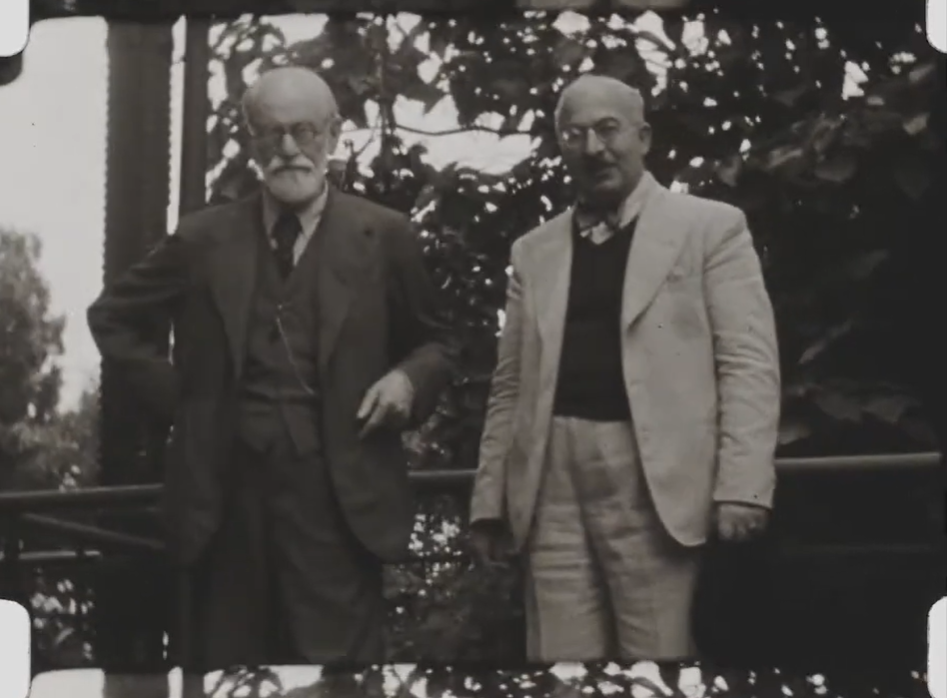
Foto: Freud wird 1937 von Arnold Zweig in Grinzing bei Wien besucht
Standbild aus Film: Bonaparte, Marie, Princess, Camera. Le Professeur Freud de Vienne à Londres par Paris--Sigmund Freud--home movies. [to 1938, 1937] Video. Retrieved from the Library of Congress (LoC), Washington, https://www.loc.gov/item/2018600880/.